
How 1000× Leverage Works: The Math Behind the Bust Price
Leverage multiplies your exposure and the move that wipes you out by exactly the same number. Here is the arithmetic, the bust-price formula, and a clear look at what 1000× really is.
Leverage is the most misread number in crypto betting. People see 1000× and understand it as a multiplier on their winnings. It is — and it is the exact same multiplier on the move that wipes them out. Both halves come out of the same arithmetic, and the second one deserves as much attention as the first.
Everything below is arithmetic that applies to leverage betting generally. Where Moon.com works differently from a conventional futures exchange — and it does, in one structural way — that is flagged explicitly. For the platform itself, see our full Moon.com review.
Leverage in one sentence#
Leverage multiplies your exposure, not your money. You put up a stake, and the platform lets you control a position worth stake × leverage. Every percentage move in the underlying asset is applied to the position, not to your stake. That is the entire mechanism — there is nothing clever hiding underneath it.
A $100 stake at 20× leverage controls a $2,000 position. If Bitcoin rises 1%, the position gains $20, which is a 20% return on your $100. If Bitcoin falls 1%, the position loses $20 and you are down 20%. The asset moved one percent. You moved twenty. The leverage number is the exchange rate between those two sentences.
| Leverage | Position size | A 0.1% move is worth | As % of your stake |
|---|---|---|---|
| 1× | $100 | $0.10 | 0.1% |
| 10× | $1,000 | $1.00 | 1% |
| 50× | $5,000 | $5.00 | 5% |
| 100× | $10,000 | $10.00 | 10% |
| 500× | $50,000 | $50.00 | 50% |
| 1000× | $100,000 | $100.00 | 100% — your whole stake |
The bust price, and how to calculate it#
Your bet busts when the loss on the position equals your stake. The loss is position size × adverse move, and position size is stake × leverage — so the stake cancels out of the equation completely. The fatal move depends only on the leverage you chose.
| Leverage | Adverse move that busts you | On a $100,000 Bitcoin price | Rough time for that move |
|---|---|---|---|
| 1× | 100% | $100,000 → $0 | effectively never |
| 10× | 10% | $10,000 | days to weeks |
| 50× | 2% | $2,000 | hours to a day |
| 100× | 1% | $1,000 | often within hours |
| 500× | 0.2% | $200 | minutes |
| 1000× | 0.1% | $100 | seconds to minutes |
In practice the bust arrives slightly earlier than the pure math suggests. The opening fee is taken from your stake, and Moon settles bets against its own quoted price, which its terms of service say contains a spread in the house's favour. At 10× they are rounding errors against a 10% buffer. At 1000×, where the whole buffer is 0.1%, they are not. Moon displays the bust price on the bet slip before you confirm — read it, compare it to the live price, every single time.
What 0.1% looks like on a live account#
The table above is arithmetic, so we checked it against the platform itself. On 22 August 2026 we funded a real Moon account and opened two 1000× bets on Ethereum, both on the price falling. In each case Moon printed a bust price on the position before anything moved — and in each case it sat almost exactly 0.1% from the entry, which is what the formula says it should be.

Two things in that screenshot are worth dwelling on. The bust price is not buried in a submenu — it has its own column, next to the entry price, updating live. And the multiplier column shows what your stake is currently worth as a multiple: 0.87× while the bet was under water, 1.06× once it moved our way. On a $0.99 wager those are cents, which is exactly why it is worth rehearsing at that size.
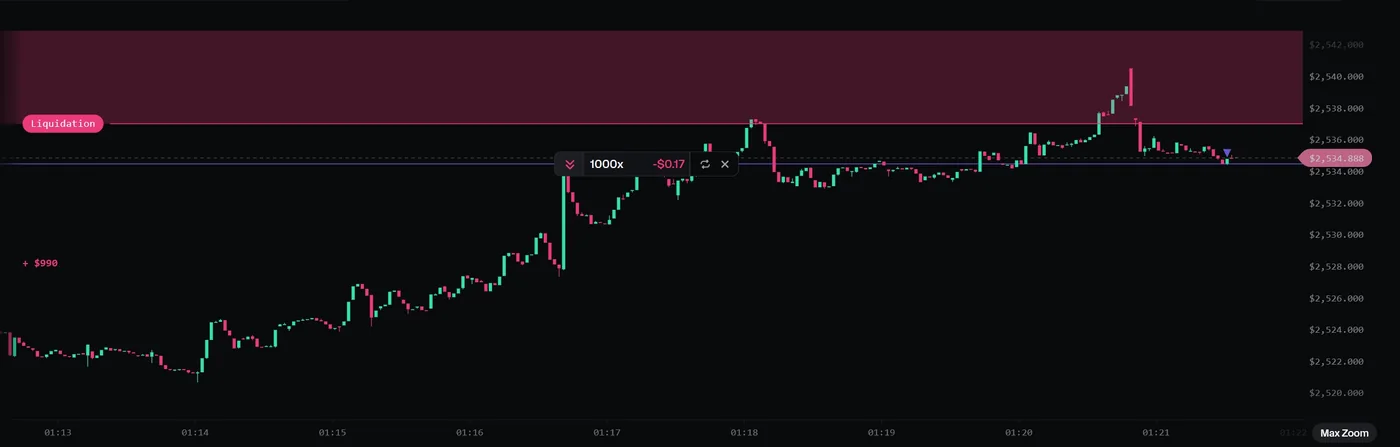
That is the honest picture of 1000× leverage: not a number on a page, but a line two and a half dollars away from a price that moves that far while you are reading this sentence.
The real difference: your maximum loss is your stake#
On a conventional futures exchange, leverage is credit. You post margin, effectively borrow the rest, and if the market gaps through your liquidation level faster than the matching engine can close you out, the shortfall is a debt. Exchanges manage that with insurance funds and auto-deleveraging, and in violent moves those mechanisms cascade: forced liquidations move the price, which forces more liquidations.
Moon does not work that way. Per its own terms, the maximum you can lose on a bet is the stake you placed on it. When the bust price is hit the position auto-liquidates and the bet is finished. There is no margin call, no negative balance and no obligation to top anything up. You cannot lose money you did not put on the table.
- ▸No negative balance — a bust takes the stake and stops there.
- ▸No margin call and no forced top-up, so a losing bet cannot pull in funds you did not commit to it.
- ▸No liquidation cascade — prices come from external feeds (DXFeed, Pyth Network, SEDA) and Moon is the counterparty, so your bust is not an order hitting a public order book.
- ▸The worst case is known before you click: it equals your stake, and the bust price is shown on the slip.
The honest part: at 1000× you are betting on noise#
Here is the part that matters most at the top of the leverage range. At 1000× your survival buffer is 0.1%. Bitcoin covers 0.1% in completely ordinary trading — not during a crash, not on a central-bank day, just on a quiet afternoon while nothing in particular is happening. Normal spread flicker on a large-cap pair is already a meaningful fraction of that distance.
Which means that at that leverage you are not expressing a view on Bitcoin. There is no chart pattern, no indicator and no headline that predicts which side of a one-tenth-of-a-percent wiggle the next few seconds land on. You are calling a coin flip on second-by-second noise — and the coin is not quite fair.
It is not fair because of the costs. Moon charges 1% of your stake to open a bet, at least 10% of any realised profit, a holding fee every 8 hours the position stays open — sized by your stake and your leverage, at a rate Moon calls dynamic and shows inside the platform — and, per its terms, a spread in its own favour inside the settlement price. Moon's terms also state plainly that Moon is the counterparty of every bet, with a disclosed financial interest in the outcome. Any one of those is small. Stacked on top of a near-coin-flip, together they are the difference between break-even and a steady bleed, which is why a staking and risk framework matters more here than any entry signal.
That is the standard structure for this product category, and Moon sets it out in its published fee schedule and terms. It also means the accurate description of a 1000× bet is high-variance entertainment with a negative expected value — not a trading strategy. At that leverage the stake is usually gone in seconds or minutes, and every cost above is subtracted from a near-coin-flip. Decide the amount before you open the tab, treat it as the price of the entertainment, and never use money that already has a job.
- ▸Up to roughly 10×: an ordinary daily range does not end the bet, so a correct directional call has room to be right slowly.
- ▸20× to 50×: you need to be right about direction and roughly right about timing.
- ▸Above 100×: timing dominates direction almost entirely — you are trading minutes, not theses.
- ▸500× to 1000×: neither analysis nor timing helps, because you are inside the noise band. Over a long run of bets, the fee structure decides the outcome.
Auto-profit and auto-loss: the only controls you actually have#
Moon lets you set an auto-profit (take-profit) and an auto-loss (stop-loss) level on a bet. At high leverage these are not optional extras — they are the only part of the outcome you still control once the bet is live. Everything else has already been decided by your stake and your leverage.
Auto-profit closes the bet automatically when your profit reaches a level you set in advance. It exists because leveraged gains disappear as fast as they appear: a 0.05% move at 500× is a 25% gain that can be gone before you have finished switching tabs. Auto-loss closes the bet at a loss you choose that sits above the bust — so you keep part of the stake instead of riding it all the way down.
- ▸Set both before you confirm the bet, not afterwards. At high leverage the window for a manual decision can be a few seconds.
- ▸An auto-loss is only meaningful if it sits comfortably inside your bust distance. At 1000× the bust is 0.1% away, so a stop at 0.08% will be picked off by ordinary noise almost immediately — the tool cannot rescue a leverage level that leaves it no room.
- ▸Treat an automatic close as a trigger level rather than a guaranteed fill price. In fast-moving markets the executed price can differ slightly from the level you set — that is true of automated exits on any platform.
- ▸Auto-profit removes the hardest decision — when to take a win — from the exact moment you are least equipped to make it.
How to learn this without paying tuition for it#
Every Moon account includes a play money mode with the full feature set, so the whole product can be run on a virtual balance before a cent of your own is involved. It is one of the most useful things on the platform, and almost nobody uses it the way they should — as a measuring instrument rather than a toy.
- Place 20 demo bets at 1000× and write down how long each one survives. That number, not an argument, is what changes people's minds about extreme leverage.
- Place the same 20 bets at 10× and count how many were eventually right about direction. The gap between the two runs is the cost of impatience.
- Practise setting auto-profit and auto-loss until it is muscle memory rather than an afterthought.
- Only then decide whether the real-money version of this is entertainment you want to buy — and at what leverage.
What does 1000x leverage actually mean?+
It means your stake controls a position 1,000 times its size. A $50 stake controls $50,000 of exposure, so every 0.01% the asset moves is worth $5 to you. The multiplier applies to gains and losses identically, which is why a 0.1% move against you removes the entire stake.
How do I calculate my bust price?+
Divide 100 by your leverage to get the percentage move that busts you: 1% at 100×, 0.2% at 500×, 0.1% at 1000×. Apply that percentage to your entry price in the direction you bet against. Moon also shows the bust price on the bet slip before you confirm — check it against the live price every time.
Can I lose more than my stake on Moon.com?+
No. Moon states that the maximum loss on a bet is the stake you placed. When the bust price is reached the position auto-liquidates and the bet ends — no margin call, no negative balance, no obligation to deposit more. That caps your downside, but it does not make losing the full stake any less likely at high leverage.
Is 1000x leverage profitable?+
The structure works against it. At 1000× the fatal move is 0.1%, which large-cap crypto covers routinely within seconds, so results are dominated by short-term noise rather than analysis. Layered on top are a 1% opening fee, a performance fee on wins, holding fees and a house spread. Expect losses and size your bets accordingly.
Is leverage betting the same as futures trading?+
Structurally, no. Futures leverage is borrowed money on an exchange, with margin calls, liquidation engines and the possibility of a negative balance. On Moon you place a fixed stake against the house and that stake is the hard cap on your loss. The trade-off is that Moon is the counterparty to your bet, and its terms disclose a spread inside its own settlement price.
What leverage should a beginner use?+
Start in demo mode in the single digits, up to around 10×. At that level an ordinary daily range does not end the bet, so you can see whether your directional calls have any merit before timing pressure buries the answer. Raise leverage only if a recorded sample of bets says you should — never because a loss needs recovering.
Sources checked
Do the 1000× experiment on play money first
Moon's demo mode gives you a virtual balance with the same markets, the same leverage range and the same bust mechanics as the real thing — and costs nothing to be wrong in. Register through our link and 3.5% rakeback on all fees is active from your first real bet, whenever you decide to place one.
Applied automatically when you register through our link — or enter it yourself at sign-up. Either way it switches on 3.5% rakeback.
Editorial note: every factual claim on this page was checked against Moon.com's own terms of service, help centre and the Anjouan licence register in August 2026. Platform terms change — verify anything decision-critical on moon.com before you act on it. This page contains advertising links; see our legal & disclosure page.