Moon.com Fees Explained: What 1000× Leverage Actually Costs
Three fees, one spread, and one detail that makes high leverage far cheaper on Moon than on a normal futures exchange. Here is the full math.
Moon.com publishes its fee structure in the help centre, and the terms of service add one further cost on top of it: the spread inside the settlement price. This page puts all of it in one place, with numbers you can check against your own bet slip.
There are three explicit fees on Moon.com and one implicit cost. The explicit ones are an opening fee, a holding fee and a performance fee. The implicit one is the house spread. Sign up through our link and you also get 3.5% of all fees returned as rakeback, active from your first bet — the details are covered in our rakeback guide.
The fee table at a glance#
| Fee | Amount | Charged on | When |
|---|---|---|---|
| Opening fee | 1% | Your stake only — not the leveraged position | When the bet opens |
| Holding fee | Dynamic — 2 bps when we checked | Your wager and leverage | Every 8 hours the bet stays open |
| Performance fee | min. 10% | Realized profit | On close, winning bets only |
| Liquidity adjustment | Variable | Close price of large positions | On close, size-dependent |
| House spread | Inside the price | Moon's quoted settlement price | Always |
The opening fee: 1%, but of what?#
This is the detail that makes Moon interesting for high-leverage bettors. The 1% opening fee is charged on your stake, not on the leveraged exposure. Bet $1,000 at 10× leverage and you control a $10,000 position — but the fee is 1% of $1,000, which is $10. Not $100.
Scale that up and the difference becomes dramatic. At 1000× leverage, a $100 stake controls $100,000 of exposure. The opening fee is $1. A futures exchange charging a typical 0.05% taker fee on notional would charge $50 on the same position — fifty times more. This single design choice is why very high leverage is economically viable on Moon at all.
The holding fee: what it costs to stay in#
Every 8 hours your bet remains open, Moon assesses a holding fee measured against your wager and your leverage. Moon publishes no fixed rate for it: its help centre calls the fee dynamic and says it varies with market conditions, asset volatility, liquidity and broader funding costs. When we checked the platform in August 2026 the rate shown was 2 basis points — 0.02% — per 8-hour window, and Moon states the applicable rate is always displayed inside the platform and folded into your position costs. Read it on your own bet slip rather than trusting any figure quoted elsewhere, including ours.
The practical consequence is that Moon is built for short-duration bets. A position held for a week crosses 21 separate 8-hour windows, and because the charge scales with leverage, a heavily geared position accrues more per window than a modest one. If your thesis needs days to play out, the holding fee stack becomes a meaningful part of your total cost.
The performance fee: 10% of what you win#
Moon takes a minimum of 10% of your realized profit on winning bets. Losing bets pay nothing — there is no performance fee on a bust. Note the wording: minimum 10%, so the applicable rate can be higher than the headline figure.
This structure is closer to a hedge fund's carry than to an exchange's commission, and it changes how you should think about win rate. A strategy that wins slightly more than it loses on gross P/L can still lose money net, because a share of every winner goes to the performance fee while every bet you open carries the opening fee.
The house spread: built into the settlement price#
Moon's terms of service state that bets settle against Moon's own quoted price, which includes a spread in Moon's favour — separate from, and in addition to, the fees listed above (§9.2). Moon is the counterparty of every bet and discloses a direct financial interest in the outcome (§5.4). That is the standard model for this product category, and Moon sets it out in its own terms. The practical takeaway is that the fee table alone does not describe your full cost.
Worked example: a $100 bet at 100× leverage#
Say you stake $100 on Bitcoin going up at 100× leverage, which gives you $10,000 of exposure. Bitcoin rises 0.5%, and you close the bet after two hours.
- Opening fee: 1% of your $100 stake = $1.00
- Gross profit: 0.5% of $10,000 exposure = $50.00
- Holding fee: $0 — you closed within the first 8-hour window
- Performance fee: 10% of $50 = $5.00
- Net before spread: $50 − $1 − $5 = $44.00
- With 3.5% rakeback: $6.00 in fees paid, $0.21 returned
Roughly 12% of your gross profit goes to fees, before the house spread. Flip the example — Bitcoin falls 0.5% instead — and the position is down $50 on a $100 stake, plus the $1 opening fee, with no performance fee owed. Another 0.5% against you and the loss reaches the stake, the bet busts, and the $100 is gone. This asymmetry is the core economics of the product.
The cost the fee table leaves out: getting paid#
None of the fees above apply when you take money off the platform — withdrawals carry their own charge. On our own test withdrawal in August 2026, Moon charged a flat $1.00 transaction fee on a USDC payout over the Solana network, with a $0.04 minimum withdrawal amount.
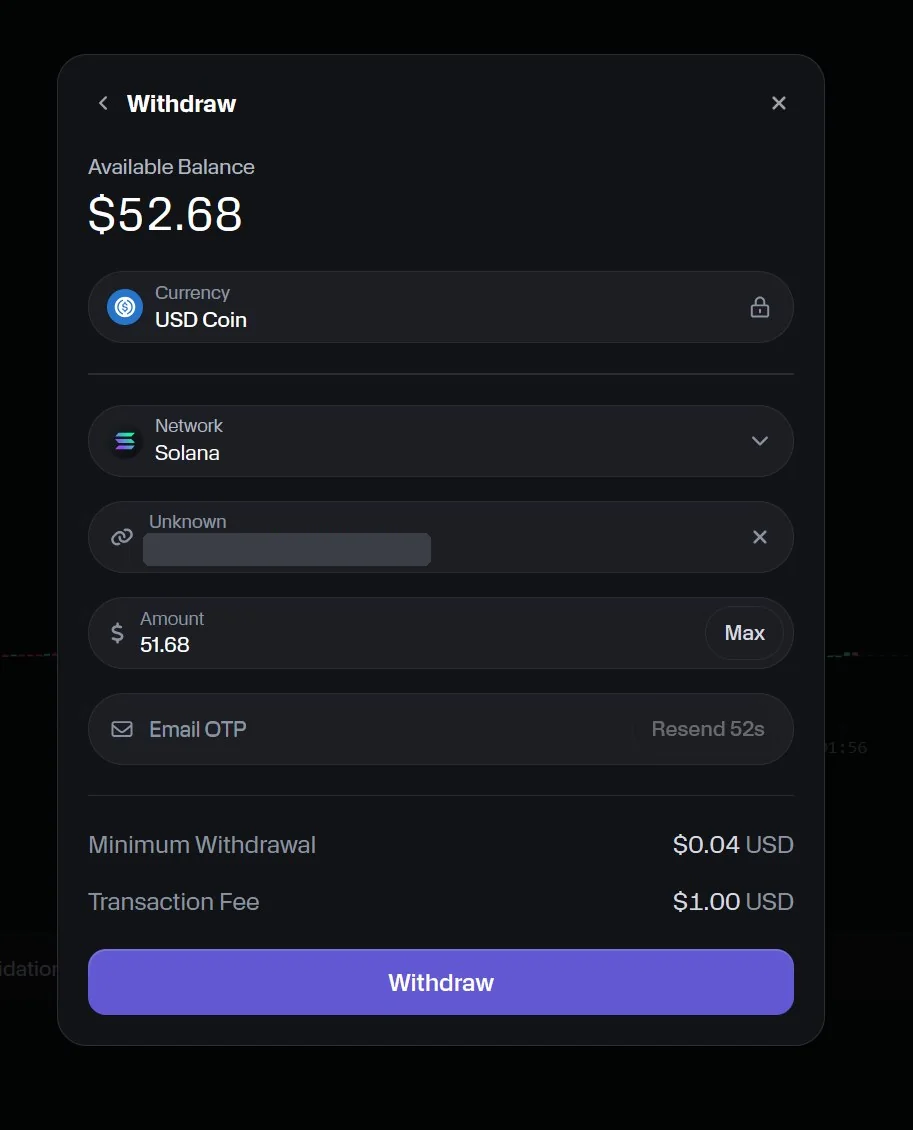
The figure applies to what we withdrew, on that network, on that day; other coins and networks carry different transfer costs, and Moon can change them. Check the amount shown on the withdrawal screen before you confirm — it is displayed there every time.
How to keep your costs down#
- ▸Close inside the 8-hour window whenever your thesis allows — every window crossed is another charge.
- ▸Use the play money mode to rehearse your approach across 20–30 bets before risking capital.
- ▸Sign up through our link so rakeback is active from your first bet.
- ▸Remember that leverage multiplies exposure, not opening cost — raising leverage to chase a bigger position does not raise your entry fee, but it does move your bust price closer.
- ▸Track your own net P/L across a run of bets so you know your real cost base.
Is the 1% opening fee charged on the leveraged amount?+
No. It is charged on your stake only. A $1,000 stake at 10× leverage controls a $10,000 position, but the opening fee is 1% of $1,000 — that is $10, not $100. This is unusual and it is the main reason high leverage stays affordable on Moon.
How much is the holding fee on Moon.com?+
Moon charges it every 8 hours a bet stays open, calculated from your wager and your leverage, but it does not publish a fixed rate — its help centre describes the fee as dynamic, varying with market conditions, volatility, liquidity and funding costs. The platform showed 2 basis points (0.02%) per window when we checked in August 2026. The applicable rate is displayed inside the platform and folded into your position costs, so read it on your own bet slip.
Do I pay a performance fee if my bet loses?+
No. The performance fee of at least 10% applies only to realized profit on winning bets. A bet that busts pays no performance fee — but you still lose your entire stake plus the opening fee.
Does Moon.com charge a spread on top of the fees?+
Yes. Moon's terms of service state that bets settle against Moon's own quoted price, which includes a house spread in Moon's favour, in addition to all listed fees. Moon is the counterparty to every bet and discloses this openly.
How do I reduce Moon.com fees?+
The one reliable lever is rakeback: 3.5% of all fees you pay is returned to your balance, on winning and losing bets alike. Register through our link and rakeback is active from your first bet; it can also unlock later via the VIP program. Beyond that, closing bets within the 8-hour window avoids repeated holding charges.
Sources checked
- 1Moon.com Help Centre — How Do The Fees On Moon Work?
- 2Moon.com Terms of Service — clauses 5.4 and 9.2 — Moon as counterparty, spread inside the settlement price
- 3Moon.com Help Centre — What is Rakeback, how it works and how to get it?
- 4Moon.com Help Centre — Moon Betting Glossary
Get 3.5% of every fee back
Rakeback is the only fee on this page you can actually change. Register through our link — promo code 1000x is applied automatically — and it runs from your first bet, with no wagering requirement. Moon is 18+ only: this is high-risk entertainment with a disclosed house spread, so stake only money you can afford to lose entirely.
Applied automatically when you register through our link — or enter it yourself at sign-up. Either way it switches on 3.5% rakeback.
Editorial note: every factual claim on this page was checked against Moon.com's own terms of service, help centre and the Anjouan licence register in August 2026. Platform terms change — verify anything decision-critical on moon.com before you act on it. This page contains advertising links; see our legal & disclosure page.